 0000-0003-4094-7453
  brigido.garciap@upr.edu.cu
Carlos Cesar Torres Paez1
0000-0001-7956-5079 carlosc@upr.edu.cuTania Vargas Fernández1
0000-0003-4285-682X tvargas@upr.edu.cu

Cooperativismo y Desarrollo, May-August 2026; 14(2), e992
Translated from the original in Spanish
Original article
Challenges of municipal public administration for workforce management
Retos de la administración pública municipal para la gestión de la fuerza de trabajo
Desafios para a administração pública municipal na gestão da força de trabalho
Brígido García Páez1 0000-0003-4094-7453 brigido.garciap@upr.edu.cu
Carlos Cesar Torres Paez1 0000-0001-7956-5079 carlosc@upr.edu.cu
Tania Vargas Fernández1 0000-0003-4285-682X tvargas@upr.edu.cu
1 University of Pinar del Río "Hermanos Saíz Montes de Oca". Cuba.
Received: 7/05/2026
Accepted: 14/07/2026
ABSTRACT
The updating process of the Cuban economic and social model granted municipalities a leading role in local development, which positioned public workforce management as a strategic function to address demographic challenges and employment transformations. This study aimed to analyze the main challenges of municipal public administration in Cuba for workforce management in local development, in order to identify institutional gaps and operational lines of action. A mixed descriptive-explanatory methodological design was employed. The sample covered the entire universe of 336 presidents of the Municipal Assemblies of People's Power and Mayors from the 168 municipalities of the country. The data collection instrument, a structured survey exploring seven management dimensions, was validated through expert judgment and achieved a Cronbach's alpha internal consistency of 0.89. Results revealed that eighty-five percent of local decision-makers negatively assessed institutional capacities, although with significant variations according to municipality size and economic structure. Critical gaps were identified in regulatory rigidity, training mismatch, and the weakness of Territorial Employment Commissions. These findings evidenced the need to overcome the current institutional fragmentation. It was concluded that municipal workforce management demands an integrative model based on four axes: local labor information system, regulatory flexibility, dual training with non-state actors, and results-based evaluation.
Keywords: municipal public administration; local development; workforce, public management.
RESUMEN
El proceso de actualización del modelo económico y social cubano confirió al municipio un papel protagónico en el desarrollo local, lo que situó a la gestión pública de la fuerza de trabajo como función estratégica para enfrentar los desafíos demográficos y las transformaciones del empleo. El presente estudio tuvo como objetivo analizar los principales retos que enfrenta la administración pública municipal en Cuba para la gestión de la fuerza de trabajo en función del desarrollo local, con el fin de identificar brechas institucionales y proponer líneas de acción operativas. Se empleó un diseño metodológico mixto de tipo descriptivo-explicativo. La muestra abarcó el universo de 336 presidentes de las Asambleas Municipales del Poder Popular e Intendentes de los 168 municipios del país. El instrumento de recogida de datos, una encuesta estructurada que exploró siete dimensiones de gestión, fue validado mediante juicio de expertos y alcanzó una consistencia interna de 0.89 en el alfa de Cronbach. Los resultados revelaron que el 85% de los decisores locales evaluó negativamente las capacidades institucionales, aunque con variaciones significativas según el tamaño y la estructura económica del municipio. Se identificaron brechas críticas en la rigidez normativa, el desajuste formativo y la debilidad de las Comisiones Territoriales de Empleo. Estos hallazgos evidenciaron la necesidad de superar la fragmentación institucional vigente. Se concluyó que la gestión municipal de la fuerza de trabajo demanda un modelo integrador basado en cuatro ejes: sistema de información laboral local, flexibilización normativa, formación dual con actores no estatales y evaluación por resultados.
Palabras clave: administración pública municipal; desarrollo local; fuerza de trabajo; gestión pública.
RESUMO
O processo de atualização do modelo econômico e social cubano conferiu ao município um papel de liderança no desenvolvimento local, posicionando a gestão da força de trabalho pública como uma função estratégica para enfrentar os desafios demográficos e as transformações do emprego. Este estudo teve como objetivo analisar os principais desafios enfrentados pela administração pública municipal em Cuba em relação à gestão da força de trabalho para o desenvolvimento local, a fim de identificar lacunas institucionais e propor linhas de ação operacionais. Foi empregado um delineamento descritivo-explicativo de métodos mistos. A amostra foi composta por todos os 336 presidentes das Assembleias Municipais do Poder Popular e prefeitos dos 168 municípios do país. O instrumento de coleta de dados, um questionário estruturado que explorou sete dimensões de gestão, foi validado por meio de revisão por especialistas e alcançou uma consistência interna de 0,89 utilizando o alfa de Cronbach. Os resultados revelaram que 85% dos tomadores de decisão locais avaliaram negativamente as capacidades institucionais, embora com variações significativas dependendo do tamanho e da estrutura econômica do município. Lacunas críticas foram identificadas na rigidez regulatória, na inadequação de habilidades e na fragilidade das Comissões Territoriais de Emprego. Essas descobertas destacaram a necessidade de superar a atual fragmentação institucional. Concluiu-se que a gestão da força de trabalho municipal requer um modelo integrado baseado em quatro pilares: um sistema local de informações trabalhistas, flexibilidade regulatória, formação dual com atores não estatais e avaliação baseada em resultados.
Palavras-chave: administração pública municipal; desenvolvimento local; força de trabalho; gestão pública.
INTRODUCTION
In recent decades, the specialized literature has consolidated a consensus around the need to link labor policies with territorial development strategies. Abramo et al. (2021) and Alburquerque (2022) have emphasized that the relationship between human capital and local development is neither automatic nor unidirectional, but rather depends on the existence of productive opportunities that allow for the utilization of acquired skills. Weller (2025) warns that, in the absence of such opportunities, peripheral territories experience brain drain that depletes their most valuable resources. From a governance perspective, Pike et al. (2022) point out that the disciplinary fragmentation between labor economics, organizational management, and territorial planning has hindered a comprehensive understanding of local development phenomena.
For its part, the literature on public management (Longo, 2022) has emphasized institutional capacities as a necessary condition for policy effectiveness, while studies on territorial development (Alburquerque, 2022; De Mattos, 2010) have underscored the importance of local actors and endogenous articulation. In the Ibero-American context, recent research has documented the heterogeneity of municipal performance in employment and development, attributing it not only to structural factors, but also to the quality of local institutions and intergovernmental coordination mechanisms (Avellaneda, 2023; Peels & Ponce Del Castillo, 2024).
In the Cuban context, the process of updating the economic and social model has placed decentralization and the strengthening of municipalities as strategic pillars for the country's development. The 2019 Constitution of the Republic reaffirmed the role of municipalities as the primary level of government, granting them the necessary autonomy to perform their functions and the power to promote local development (Musibay Figueroa et al., 2024). This political orientation recognizes that municipalities cannot be mere implementers of central directives, but rather key players with the capacity to mobilize endogenous resources, coordinate local actors, and design strategies adapted to their specific realities. However, academic research has documented persistent institutional limitations in Cuban municipalities for managing local development (Musibay Figueroa et al., 2024), as well as tensions between centralized regulatory design and the need for territorial flexibility.
Public workforce management is a critical function for the effectiveness of municipal development strategies. Cuba faces significant demographic challenges -population aging, low fertility rates, and emigration of young people and professionals- which are creating a scenario of shrinking economically active population and human capital loss in less developed areas. Simultaneously, transformations in the employment structure, with the expansion of the non-state sector (cooperatives, self-employed workers, and micro, small, and medium-sized enterprises), pose unprecedented challenges for municipal public administration. According to data from the Ministry of Labor and Social Security (MTSS in Spanish), the non-state sector employs more than a third of the working population, meaning that labor management cannot be limited to the state-funded sector but must address all labor relations within the territory.
Despite the political will expressed in the Municipal Development Strategies (MDS) and regulatory advances, academic research identifies conceptual and practical gaps in the public management of the workforce at the local level. Cuban literature has predominantly addressed human resource management from an organizational or labor economics perspective, while local development has been studied from the perspectives of economic geography and territorial planning. However, few studies integrate both perspectives into a coherent framework and offer national assessments of municipal institutional capacities to manage the workforce in support of local development.
In particular, it is unknown to what extent local government structures possess the necessary regulatory, technical, and organizational resources to integrate employment, training, and talent retention policies with territorial development strategies. Nor has it been systematically explored how territorial heterogeneity -in terms of size, productive structure, or the dynamics of the non-state sector- influences municipal performance in this area.
This article aims to analyze the main challenges facing municipal public administration in Cuba in managing the workforce for local development, based on a national assessment of institutional capacities and territorial coordination mechanisms. Specifically, it seeks to characterize gaps in regulations, qualified personnel, alignment between training programs and labor market demand, and inter-institutional coordination, as well as explore the territorial variability of these phenomena. The study aims to provide empirical evidence to guide public policy design and decision-making at the local and national levels, thus helping to overcome the fragmentation that currently hinders employment management and accelerates the human capital depletion of local communities.
MATERIALS AND METHODS
The research employed a mixed-methods descriptive-explanatory design, combining quantitative and qualitative strategies to address municipal workforce management in Cuba. The dialectical-materialist approach served as the general epistemological framework, guiding the analysis of the contradictions between centralized regulations and local needs, without constituting a research method in itself. The operationalization of the mixed-methods design was carried out in a sequence of phases: an initial quantitative phase of census data collection, followed by a qualitative phase of in-depth analysis through interviews and document analysis, and a final phase of integration and triangulation of results.
The study population consisted of all the Presidents of the Municipal Assemblies of People's Power and the Mayors of the 168 municipalities in Cuba, representing a total of 336 subjects. The decision was made to work with the entire population (census) in order to guarantee national representativeness and capture the heterogeneity of territorial realities. The effective response rate was 100%, as all local decision-makers participated.
Secondary sources included 47 documents: current legal norms (2019 Constitution, Law 116/2022, Decree Laws 69 and 72, Decree 140/2025 and resolutions of the Ministry of Labor and Social Security), the Municipal Development Strategies of the 168 territories, institutional reports of the Ministry of Labor and Social Security and the National Institute for Attention to Non-State Economic Actors (INAENE in Spanish), as well as previous scientific research on local development and labor management in Cuba.
Primary data were obtained using three instruments. First, a structured questionnaire of 48 questions was administered to 336 municipal decision-makers. The questionnaire combined multiple-choice items with a five-point Likert scale and open-ended questions for systematization. Second, two structured individual interviews were conducted with the Minister of Labor and Social Security and the President of the National Institute for Attention to Non-State Economic Actors, with the aim of comparing the vision of national strategic levels with the perceptions of local decision-makers. Third, the qualitative information was supplemented with a content analysis of programmatic and regulatory documents.
The construction of the instruments was guided by the methodology of Vallejos Díaz (2008) for empirical diagnoses, structured in four steps: 1) determination of information needs, 2) definition of sources, 3) design of data collection formats, and 4) data processing. Based on a review of the literature and regulatory documents, seven dimensions of analysis were defined: regulatory-institutional framework, institutional capacities, coordination with economic actors, labor market planning and demand, active employment policies and priority groups, job quality and social inclusion, and evaluation and control. These dimensions guided the design of the questionnaire, the interviews, and the document analysis.
The questionnaire underwent a validation process through a panel of 15 experts in public administration, local development, and human resource management, who assessed the relevance, clarity, and sufficiency of the items. Subsequently, a pilot test was administered to 20 municipal managers from different provinces, the results of which allowed for adjustments to the wording and the elimination of redundant items. The instrument's reliability was assessed using Cronbach's alpha coefficient, which yielded a value of 0.89, considered acceptable.
The fieldwork was conducted between January and June 2025. The survey was administered in person in four provinces (Pinar del Río, Artemisa, Havana, and Mayabeque), while a digital form with personalized telephone support was used for the rest of the country. This mixed-methods approach was adopted for reasons of accessibility and cost, although it is acknowledged as a methodological limitation that could introduce biases related to the administration method. To minimize this effect, the instrument's content was standardized, and the same level of technical support was provided in both modalities. Interviews with national authorities were conducted in person, audio-recorded with prior consent, and transcribed verbatim.
The processing of quantitative data was performed using SPSS version 25.0 software. Frequency analyses were applied to characterize the distributions of responses, and contingency tables were used to explore associations between decision-makers' perceptions and contextual variables (municipality size, predominant productive structure, and dynamism of the non-state sector). The significance of the associations was assessed using the chi-square test, with a significance level set at p < 0.05. The open-ended questionnaire questions and interviews were processed using thematic content analysis with Atlas.ti software, which allowed for the identification of emerging categories and recurring patterns in the perceived limitations.
The integration of quantitative and qualitative data was carried out using methodological triangulation. To this end, the findings from surveys, interviews, and document analysis were compared in a convergence matrix, which allowed for the identification of points of agreement and disagreement among the perceptions of the different management levels. Additionally, the Vester matrix was applied, and a problem tree was constructed, which made it possible to prioritize the identified challenges and establish causal relationships between the gaps detected.
The research was conducted in accordance with established ethical principles for the social sciences. Written informed consent was obtained from each participant, explaining the study's objectives, the voluntary nature of participation, and the guarantee of confidentiality. Data were anonymized using a coding system that prevents the identification of individual subjects and were stored on secure servers with access restricted to the research team. The research was approved by the ethics committee of the responsible institution. Results are presented in aggregate form, making it impossible to attribute responses to specific individuals or municipalities.
RESULTS AND DISCUSSION
Perception of the regulatory framework and municipal autonomy
The diagnosis revealed that 82% of local decision-makers (276 out of 336 respondents) rated the decentralization of labor-related powers as "insufficient" or "merely formal." This perception remained consistent across all types of municipalities, with no statistically significant differences based on size or productive structure (χ² = 4.32, df = 4, p = 0.365).
The respondents indicated that, although Decree Laws 69 and 72 and Decree 140/2025 transfer operational functions - such as the management of social security through the National Institute of Social Security - these have not been accompanied by decision-making capabilities regarding salary structure or the creation of specific incentives for strategic sectors of the municipality.
Institutional and technical capacities
The institutional capacity dimension received the highest negative rating: 85.4% of respondents (287 out of 336) negatively assessed the human, financial, and technological resources available in municipal employment offices. Specifically, 74% (249 respondents) noted a lack of specialists trained in strategic planning and labor market forecasting. This deficiency was significantly associated with the size of the municipality (χ² = 18.76, df = 4, p = 0.001): municipalities with smaller populations showed greater deficiencies (82%) compared to metropolitan municipalities (61%).
Regarding technological infrastructure, only 22% of municipalities (37 out of 168) reported having digital systems that allow for real-time matching of graduates with the demand from local businesses. The remaining 78% (131 municipalities) lack these tools, which limits the efficiency of the job market and discourages job seekers, especially young people with advanced digital skills.
Articulation with the non-state sector
93.5% of the leaders surveyed (314 out of 336) acknowledged that the non-state sector is not systematically integrated into municipal workforce planning. Territorial Employment Commissions, designed as a coordination mechanism, are not functioning adequately in 89.9% of municipalities (151 out of 168). Respondents described the meetings as "formal" and "bureaucratic," focused on meeting state employment indicators, without addressing the recruitment dynamics and training needs of the non-state sector.
Mismatch between vocational training and production demands
94.6% of managers (318 out of 336) perceived a weak match between educational offerings and local labor demand. This mismatch was more pronounced in rural municipalities with an agricultural focus (97%) than in metropolitan municipalities (89%), although the difference did not reach statistical significance (χ² = 6.54, df = 4, p = 0.162). Respondents identified unmet needs in sustainable agriculture, renewable energy management, and specialized services, while training continues to follow traditional patterns disconnected from Municipal Development Strategies.
Talent retention and job quality
92.3% of respondents (310 out of 336) identified the "brain drain" as a major concern. Only 15% of municipalities (25 out of 168) reported having active policies to retain university graduates through local incentives. Job quality was perceived as a multidimensional problem that goes beyond salary and includes living conditions, housing, services, and recreation.
Source triangulation analysis
The triangulation of the four sources of information - document analysis, interview with the Minister of MTSS, interview with the President of INAENE and survey of local decision-makers - made it possible to identify significant convergences and divergences.
Convergences: The four sources agreed in pointing out: (a) the insufficiency of municipal institutional capacities; (b) the weakness of the Territorial Employment Commissions; (c) the mismatch between training and demand; and (d) the limited municipal impact on the planning of vocational training.
Divergences: While local decision-makers emphasized regulatory rigidity as the main obstacle (82%), the Minister of Labor and Social Security attributed the limitations to the lack of preparedness of municipal staff and the absence of a "culture of territorial management." The President of INAENE, for her part, pointed out that MSMEs and cooperatives do not always report their employment needs to municipal governments, which hinders joint planning.
Complementarities: The documentary analysis provided the regulatory framework (Decree Laws 69 and 72, Decree 140/2025, draft of the Labor Code), while the interviews and surveys provided the actors' perception of the effective implementation of these regulations.
Vester matrix and problem tree
To identify and prioritize the factors hindering public workforce management, the Vester Matrix (influence analysis) was applied. The twelve problems identified from the systematization of information sources were:
The matrix was completed during a working session of the Technical Advisory Council of the Ministry of Labor and Social Security (Table 1), composed of 15 experts in public administration, local development, and labor management. Each problem was assessed for its influence on the others, using an ordinal scale from 0 to 3, where 0 = no influence, 1 = low influence, 2 = medium influence, and 3 = high influence. The final values represent the consensus reached after three rounds of discussion (adapted Delphi method).
Table 1. Influence and Dependence Matrix (Vester)
Problem |
P1 |
P2 |
P3 |
P4 |
P5 |
P6 |
P7 |
P8 |
P9 |
P10 |
P11 |
P12 |
Σ Influence |
P1 |
0 |
3 |
2 |
3 |
3 |
2 |
3 |
3 |
2 |
3 |
1 |
3 |
28 |
P2 |
2 |
0 |
2 |
2 |
3 |
1 |
2 |
2 |
2 |
1 |
1 |
3 |
21 |
P3 |
1 |
1 |
0 |
2 |
1 |
1 |
1 |
1 |
2 |
0 |
0 |
2 |
12 |
P4 |
1 |
1 |
2 |
0 |
2 |
2 |
1 |
1 |
2 |
0 |
0 |
1 |
13 |
P5 |
1 |
1 |
2 |
2 |
0 |
2 |
1 |
1 |
2 |
0 |
0 |
1 |
13 |
P6 |
2 |
1 |
0 |
0 |
0 |
0 |
1 |
2 |
2 |
1 |
0 |
1 |
10 |
P7 |
2 |
2 |
2 |
2 |
2 |
2 |
0 |
3 |
3 |
1 |
1 |
2 |
22 |
P8 |
2 |
2 |
2 |
3 |
1 |
3 |
2 |
0 |
3 |
1 |
1 |
1 |
21 |
P9 |
2 |
1 |
1 |
1 |
1 |
1 |
2 |
1 |
0 |
0 |
1 |
1 |
12 |
P10 |
1 |
1 |
1 |
1 |
1 |
1 |
1 |
2 |
1 |
0 |
1 |
1 |
12 |
P11 |
2 |
1 |
1 |
2 |
1 |
1 |
1 |
1 |
2 |
1 |
0 |
3 |
16 |
P12 |
3 |
1 |
2 |
2 |
1 |
1 |
2 |
2 |
1 |
2 |
2 |
0 |
19 |
Σ Dependence |
19 |
15 |
17 |
20 |
16 |
17 |
17 |
19 |
22 |
10 |
8 |
19 |
199 |
Source: Prepared by the author based on a working session of the MTSS Technical Advisory Council
It was observed that the problems identified by numbers P1, P2, P7, P8, and P12 are the most influential on the remaining problems; these represent the causal factors. Once the most influential, dependent factors were identified and classified according to the cause-and-effect characterizations based on the Vester matrix, a Cartesian coordinate graph was created. The highest value at both the row and column level was taken as the central point and divided by two, separating each of the scales corresponding to the Total Liabilities column (ordinate) and the Total Assets row (abscissa) into two segments. This facilitated the drawing of two new axes represented by the perpendiculars drawn from the original axes, resulting in four quadrants, with each of the problems under analysis placed within them. This entire process is illustrated in figure 1.
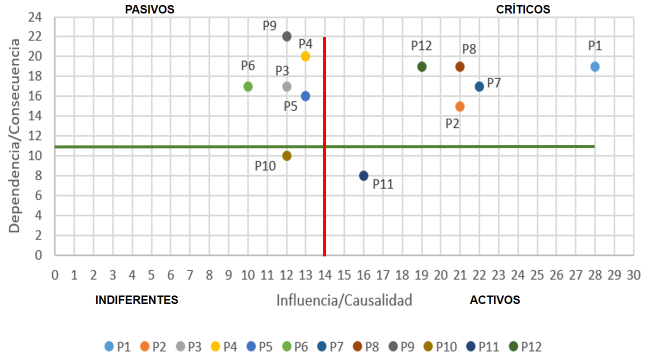
Figure 1. Chart of the factors that hinder public management of the workforce at
the municipal level
Source: Prepared by the author based on the Vester Matrix
Based on the values of influence and dependence, the problems are classified into four quadrants:
Based on the previous classification, the problem tree (Figure 2) was constructed, which hierarchizes the cause-and-effect relationships. The central problem identified was: "Insufficient institutional, technical, and financial capacities for workforce management in support of local development." Its direct causes (roots) are located in the active (P11) and critical (P2, P7, P8, P12) problems, while its consequences (branches) correspond to the passive problems (P3, P4, P5, P6, P9, P10).
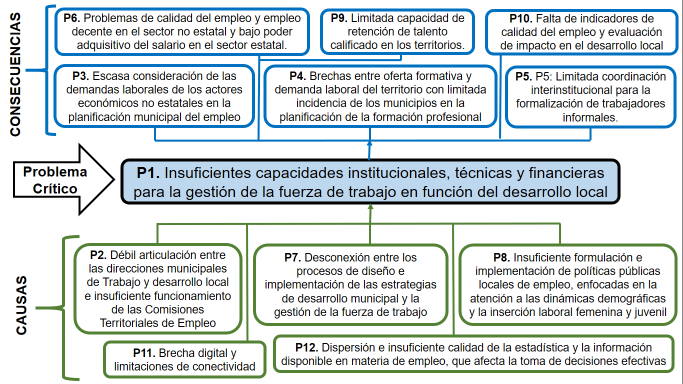
Figure 2. Problem tree
Source: Prepared by the authors
The findings confirm Pollitt and Bouckaert's (2021) thesis on the gap between administrative reform and cultural change: the transfer of operational competencies has not been accompanied by a real transfer of decision-making capacities. This phenomenon, documented in Latin American experiences (Avellaneda, 2023), takes on particular characteristics in Cuba due to the centralist tradition of its economic and social model. The perception of 82% of decision-makers regarding the inadequacy of decentralization demonstrates that, despite regulatory advances, Cuban municipalities still face limitations in exercising effective autonomy in the management of their resources and competencies (Musibay Figueroa et al., 2024).
The 85.4% negative assessments regarding institutional capacities place Cuba in a similar position to other countries in the region with incomplete decentralization processes (Peels & Ponce Del Castillo, 2024). The lack of specialists in strategic planning (74%) and the limited technological infrastructure (22% of municipalities digitized) reflect what Ramió Matas (2021) calls an "institutional intelligence deficit": the absence of information, forecasting, and evaluation systems that would allow for proactive and evidence-based management. This finding qualifies the optimistic projections of some previous studies (Fernández González et al., 2023), which attributed the limitations primarily to regulatory factors, revealing that the problem also lies in human and technological resources.
The 93.5% disconnect with the non-state sector and the 89.9% dysfunctionality of the Territorial Employment Commissions demonstrate the persistence of a vertical governance model, far removed from the collaborative governance approaches proposed by Ansell and Gash (2008). While international literature highlights the role of local governments as facilitators and coordinators of diverse interests, in Cuba a regulatory-oversight logic persists that fails to incorporate the growing diversification of economic actors. This situation contrasts with the experiences of other Latin American countries (De Mattos, 2010), where municipalities have developed public-private dialogue mechanisms for employment planning.
The 94.6% perception of a mismatch between training and demand confirms the findings of Fernández González et al. (2023) regarding the disconnect between the education system and Municipal Development Strategies. This phenomenon, which Alburquerque (2022) calls "the decapitalization of training in the territory," is not unique to Cuba, but it takes on particular severity in a context of demographic decline and skilled emigration. The limited municipal influence on vocational training planning contrasts with the need to incorporate strategic foresight approaches into territorial labor management, as noted by Peels and Ponce Del Castillo (2024).
The 92.3% concern about the "brain drain" and the fact that only 15% of municipalities have active retention policies highlight the absence of what Pike et al. (2022) call a "territorial brand": a set of incentives -not only economic but also social- that make it attractive to remain in the territory. The literature on local development (Alburquerque, 2022; De Mattos, 2010) agrees that talent retention requires integrated policies on housing, services, and quality of life, which go beyond the labor competencies of the municipal administration.
The findings confirm that municipal workforce management in Cuba faces a structural challenge that goes beyond the mere allocation of positions and requires a rethinking of the institutional model. The critical problems identified -insufficient institutional capacities (P1), weak coordination (P2), disconnect between municipal employment management and labor management (P7), insufficient local employment policies (P8), and poor quality of statistics (P12)- constitute the core causes that must be addressed as a priority.
Based on the empirical evidence presented, four operational lines of action are proposed:
These proposals differ from current approaches due to their decentralized nature, proactive orientation, and capacity to incorporate municipal heterogeneity. Their implementation will require not only political will, but also a redesign of the powers and resources allocated to local governments, as well as a national strategy for technical and financial support to prevent the fragmentation that currently hinders employment management and accelerates the loss of human capital in these regions.
The research conducted allows us to establish the following main conclusions:
REFERENCES
Abramo, P., Araque Solano, A. S., Beuf, A., Bolívar, T., Cabrera Arias, M., Carrión, F., Erazo Espinosa, J. F., Fernández Maldonado, A. M., Rodrigues Fonseca, P., García, C., Morales Pozo, L. V., Narodowski, P., Paniagua Arguedas, L., Rivera Borrayo, E., Rodríguez Mancilla, M., Santos de Souza, F. A., & Berocan Veiga, F. (2021). Procesos urbanos en acción: ¿desarrollo de ciudades para todos? III. Abya-Yala. https://biblioteca-repositorio.clacso.edu.ar/handle/CLACSO/16444
Alburquerque, F. (2022). La elaboración de estrategias territorial-ambientales: Aprendizaje de prácticas internacionales. Desarrollo y Territorio, (11), 5-11. https://desarrolloyterritorio.unvm.edu.ar/ojs/index.php/desarrolloyterritorio/article/view/562
Ansell, C., & Gash, A. (2008). Collaborative Governance in Theory and Practice. Journal of Public Administration Research and Theory, 18(4), 543-571. https://doi.org/10.1093/jopart/mum032
Avellaneda, C. (Ed.). (2023). What Works in Latin American Municipalities?: Assessing Local Government Performance. Edward Elgar Publishing. https://doi.org/10.4337/9781803929071
De Mattos, C. A. (2010). Globalización y metamorfosis urbana en América Latina. Organización Latinoamericana y del Caribe de Centros Históricos / Municipio del Distrito Metropolitano de Quito. https://repositorio.flacsoandes.edu.ec/bitstreams/d989d67a-a92f-4788-aea6-1e92637cc0cd/download
Fernández González, A., Guzón Camporredondo, A., & Núñez Jover, J. (2023). El desarrollo local en Cuba: Institucionalización y desafíos. RIGL: Revista Iberoamericana de Gobierno Local, (24). http://revista.cigob.net/24-diciembre-2023/articulos/el-desarrollo-local-en-cuba-institucionalizacion-y-desafios-T35Y
Longo, F. (2022). Mérito y flexibilidad: La gestión de las personas en las organizaciones del sector público (2a ed.). Paidós.
Musibay Figueroa, C. L., López García, Y., & Odio Pacheco, O. L. (2024). Estrategia para la gestión de proyectos de desarrollo local en el municipio Alquízar, Cuba. UNESUM - Ciencias. Revista Científica Multidisciplinaria, 8(2), 20-31. https://doi.org/10.47230/unesum-ciencias.v8.n2.2024.20-31
Peels, R., & Ponce Del Castillo, A. (2024). Utilizar la prospectiva estratégica para pensar y actuar ante un futuro incierto del mundo del trabajo. OIT. https://doi.org/10.54394/CMVD9362
Pike, A., Rodríguez Pose, A., & Tomaney, J. (2022). Local and Regional Development (3a ed.). Routledge.
Pollitt, C., & Bouckaert, G. (2021). Public Management Reform: A Comparative Analysis - Into the Age of Austerity. Oxford University Press.
Ramió Matas, C. (2021). La Administración pública del futuro (Horizonte 2050). Instituciones, política, mercado y sociedad de la innovación. Tecnos.
Vallejos Díaz, Y. A. (2008). Forma de hacer un diagnóstico en la investigación científica. Perspectiva holística. Teoría y praxis investigativa, 3(2), 11-22. https://dialnet.unirioja.es/servlet/articulo?codigo=3700944
Weller, J. (2025). Empleos verdes y sistemas de protección social: Aportes a la transformación del modelo de desarrollo. Comisión Económica para América Latina y el Caribe. https://www.cepal.org/es/publicaciones/81886-empleos-verdes-sistemas-proteccion-social-aportes-la-transformacion-modelo
Conflict of interest
Authors declare that they have no conflicts of interest.
Authors' contribution
Brígido García Páez, Carlos Cesar Torres Paez and Tania Vargas Fernández designed the study, analyzed the data, and prepared the draft.
Brígido García Páez and Carlos Cesar Torres Paez were involved in data collection, analysis, and interpretation.
All the authors reviewed the writing of the manuscript and approve the version finally submitted.
